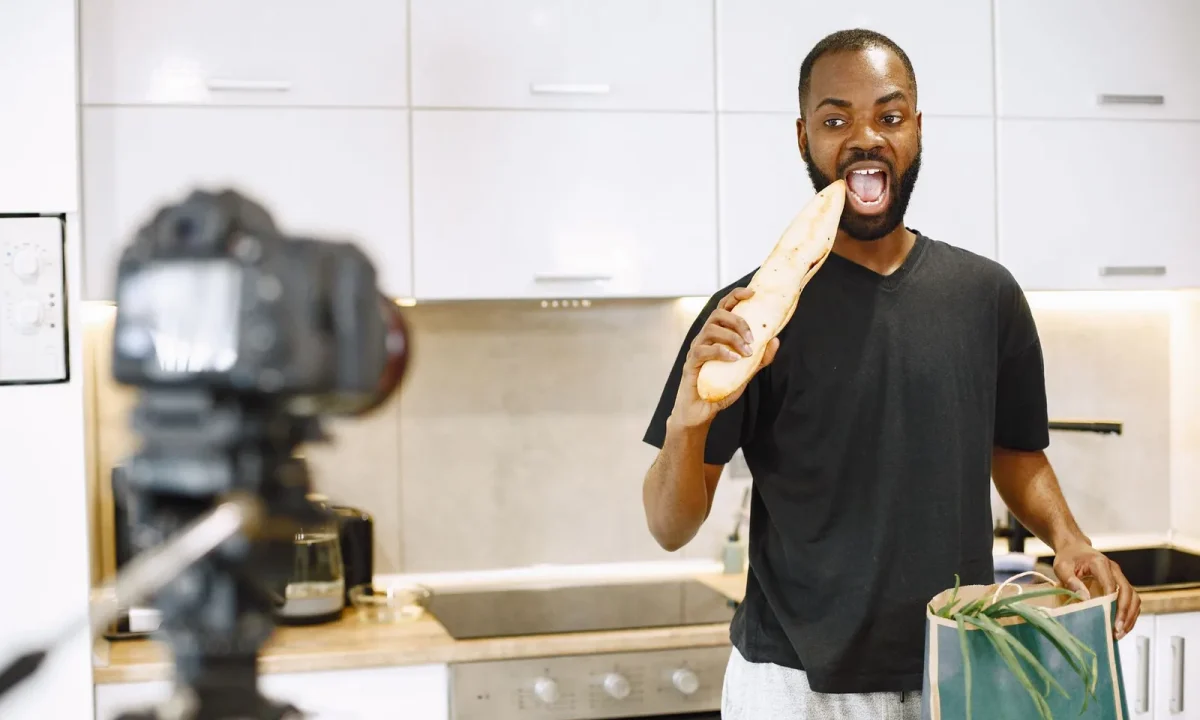
Feeling nervous in front of a lens is one of the most common hurdles for content creators, video producers, and educators. The good news is that on-camera confidence is a trainable skill, not a personality trait. In this guide you will find confidence tips for presenters, practical body language advice for working with teleprompters, and strategies for overcoming anxiety that you can start applying in your very next recording session.
Why Beginners Lose On-Camera Confidence
Most people who struggle on camera are not lacking talent; they are responding normally to an unfamiliar and self-conscious situation. When a lens points at you, your brain treats it as social scrutiny, and that triggers the same alertness you would feel speaking to a room full of strangers. Understanding why confidence dips makes the problem feel fixable instead of permanent, which is the first step toward rebuilding it.
The spotlight effect: how much viewers really notice
The spotlight effect is the tendency to overestimate how much other people notice about your appearance and behavior. Viewers watching your video are focused on your message, your tone, and whether the content helps them; they rarely register the small stumbles that feel enormous to you. Studies on social perception generally suggest we overestimate the attention others pay to our flaws, which means the tiny voice crack you replayed ten times in your head likely passed unnoticed. Reminding yourself of this before you hit record can immediately take the pressure off. When you stop assuming every viewer is grading you, it becomes much easier to relax into your delivery.
Unfamiliarity with equipment and setup
A surprising amount of on-camera anxiety comes from the gear rather than the performance itself. When you are unsure whether the microphone is level, the lighting is flattering, or the teleprompter is scrolling at the right speed, your attention splits between technical worry and actual delivery. That divided focus makes you feel clumsy, which then feeds the belief that you are “bad on camera.” The fix is simply repetition with your own setup: run the same lighting, framing, and prompter checks until they become automatic. Familiarity turns your equipment from a source of threat into a background detail you barely think about.
Fear of mistakes and the pressure of retakes
Beginners often approach each take as if it must be perfect, so every misread line or awkward pause feels like evidence of failure. This fear creates a paradox: the more you dread retakes, the tenser you become, and the more retakes you actually need. Professional creators rarely deliver flawless first takes either; they simply expect imperfection and plan for it. Reframing retakes as a normal part of the process removes their emotional weight. Once mistakes become routine data instead of personal judgments, your on-camera confidence stops swinging with every take.

Body Language With Teleprompters: Staying Natural
Teleprompters solve the memory problem but can introduce a new one: the frozen, eyes-glued-to-the-screen look. The good news is that body language with teleprompters is manageable once you understand how reading affects your posture and gestures. Your goal is to use the prompter as a tool while letting your body behave as though you are having a conversation, because viewers respond far more to warmth and movement than to flawless word delivery.
Keeping eye contact while reading
The single most important technique is placing your teleprompter as close to the camera lens as physically possible, so the line between “looking at the script” and “looking at the viewer” nearly disappears. Even a few inches of distance can make your gaze look off-axis, which viewers register as distraction. Many presenters also find it helpful to read slightly ahead of what they are saying, letting the words land in their mind before they speak them, which keeps the eyes moving naturally instead of locking onto a single line. If your setup allows it, choosing a prompter that sits directly behind or around the lens will do most of the work for you. For a deeper breakdown of this technique, see our guide on Mastering Body Language with Teleprompters: A Complete Guide.
Gestures that reinforce your message
Reading often causes presenters to clamp their hands at their sides or grip the podium, because their brain treats the script as the primary task. Counter this deliberately by planning two or three simple hand gestures for key points, the same way you would in a live presentation. Gestures should be small, purposeful, and timed to emphasis rather than constant motion, since exaggerated movement can look restless on camera. If you notice your hands going dead, pause, take a breath, and reset with a single open-palm gesture. Over time this becomes automatic, and your delivery starts to look engaged rather than recited.
Posture and movement that read well on camera
Posture shapes how confident you appear before you say a single word. Stand or sit with your weight balanced, shoulders relaxed and slightly back, and your head level with the lens; this projects steadiness without stiffness. Small shifts of weight and gentle leaning toward the camera when emphasizing a point add life to the frame, while remaining rooted in one rigid position makes even a great script feel flat. Practice your delivery while watching a recording of yourself specifically for posture, not content, so you can correct habits you would otherwise never notice.
Confidence Tips for Presenters Before Recording
The minutes before recording have an outsized effect on how you sound, and a consistent pre-session routine removes most avoidable stress. Treat preparation as part of the performance rather than as admin work, because each familiar step signals to your nervous system that you are in control. These confidence tips for presenters are quick to adopt and compound over time.
Warm-up routines for voice and face
Your voice and facial muscles behave differently on camera than they do in casual conversation, so a short warm-up prevents the flat, tight delivery that beginners often mistake for “being bad at this.” Spend three to five minutes humming, doing gentle lip trills, and reading a paragraph aloud at varying speeds to loosen your articulation. Facial warm-ups such as exaggerated smiles, wide jaw stretches, and eyebrow raises help your expressions read clearly at video scale, where subtle movements can disappear. Many presenters also find that speaking a few sentences with故意 exaggerated energy produces a more natural-looking baseline once the camera flattens it slightly. Consistency matters more than duration: a brief daily warm-up beats an occasional long one.
Rehearsing until the script feels conversational
A script you have never spoken aloud will always sound scripted, no matter how well it is written. Read your material through several times, then paraphrase key sections in your own words, and finally deliver it once as if explaining the topic to a colleague. This layered rehearsal builds familiarity without demanding memorization, which means you can recover gracefully from a misread line instead of freezing. It also helps you spot clunky phrasing early, when revising is still easy. When the script feels like something you would actually say, your shoulders drop and your tone opens up.
Setting a calm recording environment
Your surroundings directly affect your stress level, so design the space to feel predictable rather than improvised. Silence notifications, close unnecessary tabs, set your lighting and framing before you start, and keep water within reach. A tidy background and a stable camera position remove the low-grade uncertainty that keeps your mind half-focused on logistics. If other people are in the space, agree on a quiet window for recording so interruptions do not break your concentration. The aim is a setup you can recreate identically every session, because repetition breeds comfort.
Overcoming Anxiety With Simple Mental Techniques
Even well-prepared presenters feel a spike of nerves right before record, and that is not a sign of weakness. Anxiety is your body mobilizing attention, and the strategies below help you direct that mobilization toward your delivery instead of against it. These techniques for overcoming anxiety take seconds to apply, which makes them realistic even on a stressful day.
Reframing nerves as energy
The physical sensations of anxiety—racing heart, shallow breath, heightened alertness—are nearly identical to the sensations of excitement. Research on emotional appraisal suggests that labeling the same arousal as “excitement” rather than “fear” can improve performance, because you stop spending energy fighting the feeling. Try saying out loud, “I am energized and ready,” immediately before your first take, and notice how your posture responds. This does not eliminate nerves; it converts them into forward momentum. Over several sessions, the reframe becomes your default interpretation of pre-record jitters.
Breathing exercises for pre-record jitters
Controlled breathing is the fastest physiological lever you have for calming the nervous system. A simple pattern—inhale through the nose for four counts, hold for four, exhale slowly for six to eight—slows the heart rate and interrupts the shallow chest breathing that anxiety produces. Do two or three cycles while the camera is rolling its first seconds, since the warm-up take rarely matters anyway. Pairing the exhale with relaxed shoulders creates a physical cue you can repeat before every take. Within a few sessions, the breathing pattern alone will begin to trigger a calmer state.
Focusing on the message instead of yourself
Self-monitoring—wondering how you look, sound, or come across—is the single biggest drain on on-camera confidence. Shift your attention outward by asking yourself, before each take, what one thing the viewer should walk away with. When your mental energy goes into delivering value rather than evaluating yourself, the self-conscious loop breaks naturally. This focus shift is easier when your script is clear and your prompter is reliable, which is exactly what the Creating Engaging Content with Teleprompters approach is built around. The more convinced you are that the content matters, the less room anxiety has to occupy.
Using Your Teleprompter as a Confidence Anchor
A well-configured teleprompter does more than hold your lines; it becomes a stable reference point that your nervous system learns to trust. When the words are reliably where you expect them, you free up the mental bandwidth needed for expression and connection. Treating prompter setup as a core part of your confidence strategy rather than a convenience is one of the highest-leverage moves you can make.
Adjusting scroll speed to match your natural pace
Prompter discomfort almost always traces back to scroll speed. Too fast and you rush, lose your place, and feel panicked; too slow and you stall, which makes your delivery halting. Set the speed during a practice run by speaking at your most comfortable conversational pace, then adjust until the text leads you by a line or two rather than racing ahead. Most modern tools let you fine-tune this, and the right setting should feel almost invisible. Once the pace matches you, the prompter stops being an obstacle and starts functioning as a guide.
Practicing with the teleprompter until it disappears
The goal of prompter practice is the moment where reading stops feeling like reading. Start with short passages, deliver them twice, and gradually increase length while keeping your eyes soft rather than fixed. Over repeated sessions, word recognition becomes faster than conscious reading, and your gaze begins to behave naturally again. If you want a structured path, our Step by Step On-Camera Confidence with a Teleprompter walkthrough breaks this progression into stages. By the time the prompter “disappears,” you will find your delivery noticeably calmer.
Turning technical preparation into a comfort ritual
Rituals reduce anxiety by making the unpredictable feel scripted. Build a fixed sequence—open the script, test the scroll, check framing, take three breaths, say your opening line—and repeat it identically before every recording. Because the sequence never changes, your brain stops treating setup as a source of unknowns. Many presenters report that the ritual itself becomes a trigger for focus, similar to how athletes use pre-performance routines. Over weeks, this consistency quietly transforms your relationship with the record button.
Practice Drills to Strengthen On-Camera Confidence
Confidence responds to volume of quality practice, not to wishing it into existence. The drills below are deliberately short and low-stakes so that you can perform them often without burning out. Choose one to start with today and rotate through them across the week.
The one-take challenge
The one-take challenge means recording a complete segment without stopping, no matter what happens. If you stumble, you keep going and repair the sentence in real time, exactly as you would in conversation. This drill teaches your brain that mistakes are survivable, which directly weakens the fear of errors that sabotages beginners. It also improves recovery skills, which transfer to live presentations and interviews. After a few runs, you will notice your delivery loosening because perfectionism has been removed from the equation.
Recording short daily videos
Frequency beats intensity when building any performance skill. Record a sixty- to ninety-second clip each day—no editing, no publishing required—on any topic you know well. The repetition normalizes seeing yourself on screen and shortens the emotional recovery time after each take. Within a few weeks, the mere act of framing yourself and pressing record becomes unremarkable. For related strategies on consistency, see Boosting On-Camera Confidence: Essential Tips for Success.
Reviewing footage with a constructive checklist
Unstructured rewatching tends to devolve into self-criticism, so give your review a fixed structure. Use a short checklist covering eye contact, posture, pace, filler words, and one strength you demonstrated, and limit yourself to two improvement notes per session. This keeps feedback specific and actionable rather than vague and discouraging. Written notes let you measure progress objectively across weeks, which is motivating when daily change feels invisible. A disciplined review habit is what separates repeated experience from repeated mistakes.
Common Confidence Mistakes to Avoid on Camera
Some habits quietly erode progress even when you are practicing consistently. Recognizing them early saves weeks of frustration and helps you keep moving forward with less self-judgment.
Over-scripting and sounding robotic
Scripts written for the eye rather than the ear produce delivery that sounds stiff and rehearsed. Long sentences, dense clauses, and formal vocabulary force you to concentrate on decoding rather than communicating, which flattens your tone. Write in short spoken sentences, read every draft aloud, and cut anything you would never actually say. The more conversational your script, the more room your personality has to come through. For more on structuring scripts that support natural delivery, explore Boost Your Presentation Skills: Essential Confidence Tips for Presenters.
Apologizing for every small slip
Frequent apologies draw attention to errors viewers would otherwise ignore and signal insecurity that undermines your authority. Unless something genuinely affected the audience, simply restate the sentence and continue. Audiences are remarkably forgiving of minor stumbles; what they notice is the presenter stopping the flow to self-flagellate. Replacing “sorry, let me start again” with a calm restart keeps momentum intact. Over time this habit alone can transform how confident you appear.
Comparing your first takes to polished creators
Most polished videos you admire are the product of editing, retakes, and years of practice, yet it is tempting to measure your first attempts against their final cut. This comparison is unfair and unproductive, because you are comparing your behind-the-scenes with someone else’s highlight reel. Focus instead on the delta between your own sessions: clearer eye contact, calmer posture, fewer retakes. Progress that is visible in your own footage is the only comparison that actually helps.
Turning Practice Into Lasting On-Camera Confidence
Short bursts of practice create momentum, but lasting confidence comes from systems that keep you improving over months. The goal is to make recording a routine part of your workflow rather than a special event you brace for.
Tracking progress across sessions
Keep a simple log for each recording session: date, topic, number of takes, and one observation about your delivery. Reviewing the log monthly reveals patterns you cannot see session to session, such as faster recovery from mistakes or fewer filler words. Seeing documented improvement is a powerful antidote to the feeling that nothing is changing. Even a few lines per session is enough to make growth tangible.
Building a repeatable pre-record routine
A repeatable routine compresses everything that calms you—warm-up, environment check, breathing, prompter setup—into a sequence you can run anywhere. When the routine is fixed, only the content changes, and that predictability lowers anxiety substantially. Aim to make the routine short enough that you never feel tempted to skip it, ideally under fifteen minutes. Over time, the routine itself becomes the signal that it is time to perform.
Celebrating small wins to stay motivated
Motivation sustains itself when you acknowledge progress deliberately. Mark milestones such as finishing your first ten one-take drills, posting a video you previously would have abandoned, or receiving a compliment on your delivery. These acknowledgments reinforce the behavior and keep practice from feeling like an endless grind. If you want more ideas on maintaining momentum, Enhancing On-Camera Confidence: Practical Tips for Success offers additional strategies. Consistency, supported by visible progress, is what turns practice into durable on-camera confidence.
Conclusion
On-camera confidence grows from preparation, mindful body language, and steady practice rather than from talent alone. By using your teleprompter as a reliable anchor, applying confidence tips for presenters, and working through anxiety with simple mental techniques, you can move from hesitant to assured in front of the lens. The strategies in this guide are intentionally small and repeatable, because confidence is built through accumulated evidence that you can handle the record button—not through a single dramatic breakthrough. Start with one small drill today, whether it is a ninety-second daily clip or a breathing exercise before your next take, and let consistency do the rest. If you want to keep building, revisit Boosting On-Camera Confidence: Tips for Presenters and Speakers and Where On-Camera Confidence Breaks Down and How to Recover whenever you hit a plateau.
Frequently asked questions
Why do I feel so awkward on camera even though I’m confident in person?
A camera removes the real-time feedback you normally read from a listener’s face, so your brain interprets the silence and stillness as rejection or danger. Add the knowledge that you’re being recorded and will later judge yourself, and even socially confident people freeze. The effect fades as your brain learns the camera is a safe, neutral object — usually after repeated exposures, not after one pep talk.
How long does it usually take to stop looking nervous on camera?
Most beginners see a noticeable shift after 10 to 15 short recorded takes spread over two to three weeks, because desensitization happens through repetition rather than duration. Practicing daily for two minutes beats one long monthly session. If progress stalls, the problem is often preparation or mindset, not camera time.
Should I memorize my script word for word to sound more confident?
Verbatim memorization usually increases stiffness, because you end up performing recall instead of communicating. Instead, memorize your key points and a strong opening and closing line, then speak the rest in your own words. You’ll sound more natural and recover faster when you lose your place.
Why does my voice sound wrong in recordings, and will that go away?
You normally hear your voice partly through bone conduction, which adds bass that recordings don’t capture, so playback sounds higher and thinner to you than to anyone else. Listeners hear the recorded version as perfectly normal. The discomfort fades with repeated exposure, and improving mic placement helps far more than trying to change your voice.
Should I look directly into the camera lens while speaking?
Looking just below or beside the lens is fine for most talking-head content, and staring rigidly at it can make you look intense and unnatural. Place the lens at eye level, keep your eyes mostly near it, and glance away the way you would in a real conversation. Consistency matters more than perfect eye contact.
Does confidence on camera actually come from body language and breathing?
Physical setup drives most of the visible confidence: a slightly wider stance, relaxed shoulders, and slow exhales before you start lower your stress response and steady your voice. Pausing deliberately also reads as authority rather than as forgetting your lines. Fixing these fundamentals produces faster results than trying to think your way into confidence.
Recording with a script? Try Lumi.
Keep your script near the camera and out of your final video. Try free for 3 days.
Learn more